
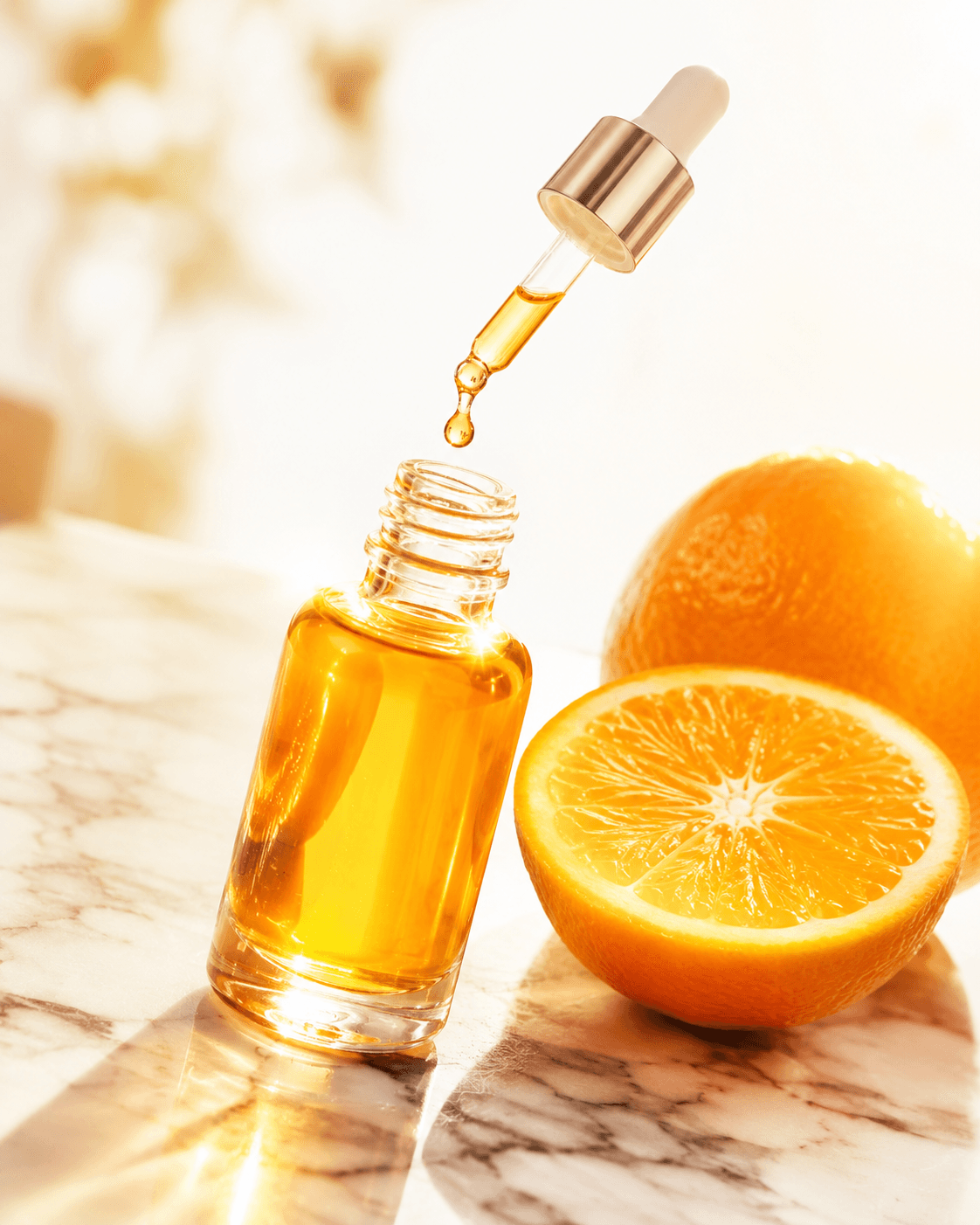
I came to vitamin C late, and I'm still a little annoyed about it. I spent years reading that it was overpriced and overhyped, tried a couple of cheap bottles that turned orange within a month and did nothing, and wrote the whole category off. It took a proper L-ascorbic acid serum -- the kind that's actually formulated to work -- to change my mind. Within six weeks my skin tone was visibly more even and some post-acne marks I'd been half-ignoring for years had faded noticeably. I haven't gone without it since.
The issue isn't whether vitamin C works. The clinical evidence is solid and it matched what I experienced. The issue is that most vitamin C serums on shelves either use unstable forms that oxidise before they do anything useful, or stable forms that work more slowly and don't deliver the same results. Picking the wrong one is how people end up concluding it doesn't work.
Here's what I've worked out.
What Vitamin C Does for Skin
Brightening and Evening Skin Tone
Around week six, I realised the post-acne marks I'd mostly stopped thinking about had actually faded. My overall tone looked more consistent -- less like I needed concealer everywhere, more like I just had reasonably even skin on a normal day.
What's actually happening is vitamin C slows down the enzyme your skin uses to produce melanin. Nothing happens overnight. But somewhere around the four to eight week mark, things start to look a bit different. A bit more even. A bit less patchy.
Antioxidant Protection
This benefit is invisible in real time, which makes it easy to undervalue. UV and pollution cause oxidative damage in skin every day -- quietly, cumulatively. Vitamin C neutralises a lot of that before it builds into something you can actually see.
It doesn't replace SPF -- it doesn't block UV. But used together in the morning, vitamin C under sunscreen gives you better protection than either one alone. I think of it as a second layer of defence that SPF by itself doesn't cover.
Collagen Support
I'd be lying if I said I noticed the collagen effect early on. It's a slow-build thing -- 3-6 months rather than 6 weeks. But vitamin C is directly involved in how skin maintains collagen, and skip it long enough and the difference eventually shows. Topical application supports the process, particularly at 10% or higher concentration.
Photoprotection
There's actual data showing that vitamin C applied before sun exposure reduces the kind of redness that builds into longer-term damage. Not a sunscreen replacement -- more of a buffer. Morning use before SPF is the point.
The Problem With Most Vitamin C Serums
The most effective form is L-ascorbic acid. It's also the most unstable. Air, light, and heat oxidise it quickly -- which is why so many vitamin C serums turn orange or brown in the bottle and stop working weeks after you open them.
I threw away two of these before I understood what was happening. A fresh L-ascorbic acid serum should be clear to very pale yellow. Anything darker than that and you're applying something that no longer does the job -- and may actually irritate your skin in the process.
The 10-20% concentration range is where L-ascorbic acid actually works. Anything under 10% barely registers. pH matters too -- needs to be under 3.5, acidic enough to actually get into skin. It's never on the label, so I look it up on the brand's website before committing. Packaging: opaque bottle with a pump -- not one of those clear droppers, which are basically a countdown to an oxidised serum. And if the formula includes vitamin E and ferulic acid alongside it, that's worth paying for -- the combination holds up longer and works harder.
Vitamin C derivatives are the stability solution. The ones you'll see most are ascorbyl glucoside and sodium ascorbyl phosphate. They convert to active vitamin C in skin, don't go bad on you, and are generally easier to layer with other actives. My hesitation with them has always been speed -- you're trading potency for stability. That depends entirely on your skin and your timeline.
What to Look For on the Label
L-Ascorbic Acid: You want it in the 10-20% range. Under 10% and you'll barely notice it doing anything. I spent a while using 20%+ thinking I was being thorough -- my skin had other opinions about that.
Vitamin E and Ferulic Acid: Seeing both of these alongside L-ascorbic acid in the same formula is a good sign. The combination holds together better and tends to work harder. SkinCeuticals built their reputation on exactly that.
Packaging: Has to be opaque or dark glass with an airtight pump. The clear dropper bottles look fine but they're basically a timer on how fast the formula goes bad. I stopped buying them years ago.
pH: Rarely on the label, which is annoying. Has to be under 4.0 for L-ascorbic acid to actually penetrate. I look it up on the brand's website before buying if I'm not sure.
Derivatives: Ascorbyl glucoside and sodium ascorbyl phosphate are the two I see most. Both work fine -- just slower than L-ascorbic acid, which is the trade-off you're making for the stability.
As an Amazon Associate, I earn from qualifying purchases.Best Vitamin C Serums for Face
Best Overall: SkinCeuticals C E Ferulic
This one comes up every time I ask a dermatologist what they actually use. 15% L-ascorbic acid with vitamin E and ferulic acid, in a formula that's been through proper peer-reviewed research. Photostable, and it does what it says -- the one that set the standard everything else gets measured against.
$185 a bottle. Real money, and I'm not going to pretend otherwise. I've bought it twice. Neither time did I feel like I'd wasted my money, but I know it's not a realistic option for everyone. SkinCeuticals C E Ferulic
Best Budget L-Ascorbic Acid: TruSkin Vitamin C Serum
Around $20. Goes higher than most at this price -- 20% L-ascorbic acid, plus vitamin E and hyaluronic acid. Stability isn't on par with SkinCeuticals, but at $20 you can replace it every couple of months without flinching. That matters more than people realise with an ingredient that degrades this fast. I've pointed people toward this one a fair few times. TruSkin Vitamin C Serum
Best for Sensitive Skin: La Roche-Posay Pure Vitamin C Face Serum
It's 10%, fragrance-free, and my skin handled it much better than anything stronger I'd tried at that point. There's also 0.5% salicylic acid in there -- I was sceptical when I noticed that, but it functions as mild exfoliation without dominating the formula. Around $40. If actives have given you grief before, this is a sensible place to start. La Roche-Posay Pure Vitamin C Face Serum
Best Mid-Range: Drunk Elephant C-Firma Day Serum
15% L-ascorbic acid with ferulic acid and pomegranate enzyme. Properly formulated and stable. Around $90, which puts it squarely between the budget options and SkinCeuticals -- not a cheap imitation, not the splurge. It earns its place in that middle tier. Drunk Elephant C-Firma Day Serum
Best Stable Derivative: The Inkey List Vitamin C Serum
Around $12 and uses ascorbyl glucoside -- a stable vitamin C derivative that doesn't oxidise and plays well with other actives. It won't give you the same speed as L-ascorbic acid, but it works consistently and won't go to waste sitting in your bathroom. I keep one as a travel option and for lower-maintenance weeks. The Inkey List Vitamin C Serum
Best for Dark Spots Specifically: Murad Rapid Age Spot and Pigment Lightening Serum
Hyperpigmentation is the whole point here, not a secondary benefit. It combines vitamin C with other spot-fading ingredients rather than being a general-purpose antioxidant serum. Around $75. If dark spots are your actual priority, this is worth the premium over a standard formula — and you'll get more out of it if you've read up on skincare for hyperpigmentation first. Murad Rapid Age Spot and Pigment Lightening Serum
How to Use Vitamin C Serum
Morning, on clean dry skin. Vitamin C earns its place in the morning, when there's UV and pollution for it to work against. And dry skin only -- I've applied it to damp skin and the formula just doesn't land properly. Give it a moment after cleansing.
Vitamin C first, then moisturiser, then SPF. That order matters. SPF goes on last, always. The full sequence for every step is in the skincare routine order guide.
3-4 drops is enough. Spread evenly, avoid the eye area. I give it about 60-90 seconds before applying moisturiser -- L-ascorbic acid needs a moment to penetrate, and layering over it immediately can get in the way of that.
Pairing With Other Actives
With niacinamide: Fine. The old concern about them causing a flushing reaction together has been tested and it doesn't hold. I use both in the same morning routine without any issue. See can you mix niacinamide and vitamin C for the full breakdown.
With retinol: I've never had a problem using both -- I just keep them apart. Vitamin C in the morning. Retinol at night. That's where each one does its job.
With glycolic acid or AHAs: Best to separate these. Both require a low pH and layering them together creates unnecessary irritation. Morning vitamin C, evening AHAs -- that split has worked consistently well for me.
How to Tell If Your Vitamin C Serum Has Oxidised
Fresh L-ascorbic acid: clear to barely yellow. Pale straw -- fine. Anything noticeably yellow, orange, or brown means oxidation has set in and the bottle should be replaced.
An oxidised serum isn't just ineffective -- it can cause skin sensitivity. I once kept using a bottle that had clearly gone orange, telling myself I'd get something out of finishing it. My skin disagreed with that plan.
To extend shelf life: keep it somewhere cool and dark. Refrigeration genuinely helps. Three to six months once opened is my rule. If the colour shifts before that point, I swap it out.
Frequently Asked Questions
How long does vitamin C serum take to work?
The brightening and radiance stuff tends to show first -- usually 2-4 weeks. Spots and post-acne marks take 6-12 weeks. The firmness end of things is a 3-6 month project if you're consistent. Every time someone messages me after a few weeks on it, the glow is the first thing they bring up.
Can I use vitamin C serum every day?
Yes -- daily morning use is the standard and suits most skin types. If yours tends to react, start every other day and give it a couple of weeks before you shift to daily. No need to rush it.
Is vitamin C serum good for acne-prone skin?
It is, particularly for the marks left behind after breakouts. Vitamin C doesn't cause spots, and it speeds up how quickly the discolouration fades. If spots are your main issue, look specifically at sodium ascorbyl phosphate -- it actually has some antimicrobial activity against acne bacteria that the other forms don't.
Should I refrigerate my vitamin C serum?
Technically optional, but mine lives in the fridge. For L-ascorbic acid formulas it actually extends how long they stay effective. Derivatives are more stable so they don't need it as much, but it won't do any harm to keep those cold too.
Can I use vitamin C serum under my eyes?
The skin under your eyes is thinner and most face serums are too strong for it. I've seen people try and regret it pretty quickly. If you want vitamin C around your eyes, find something actually formulated for that area -- don't just dab your face serum a bit lower and hope for the best.