
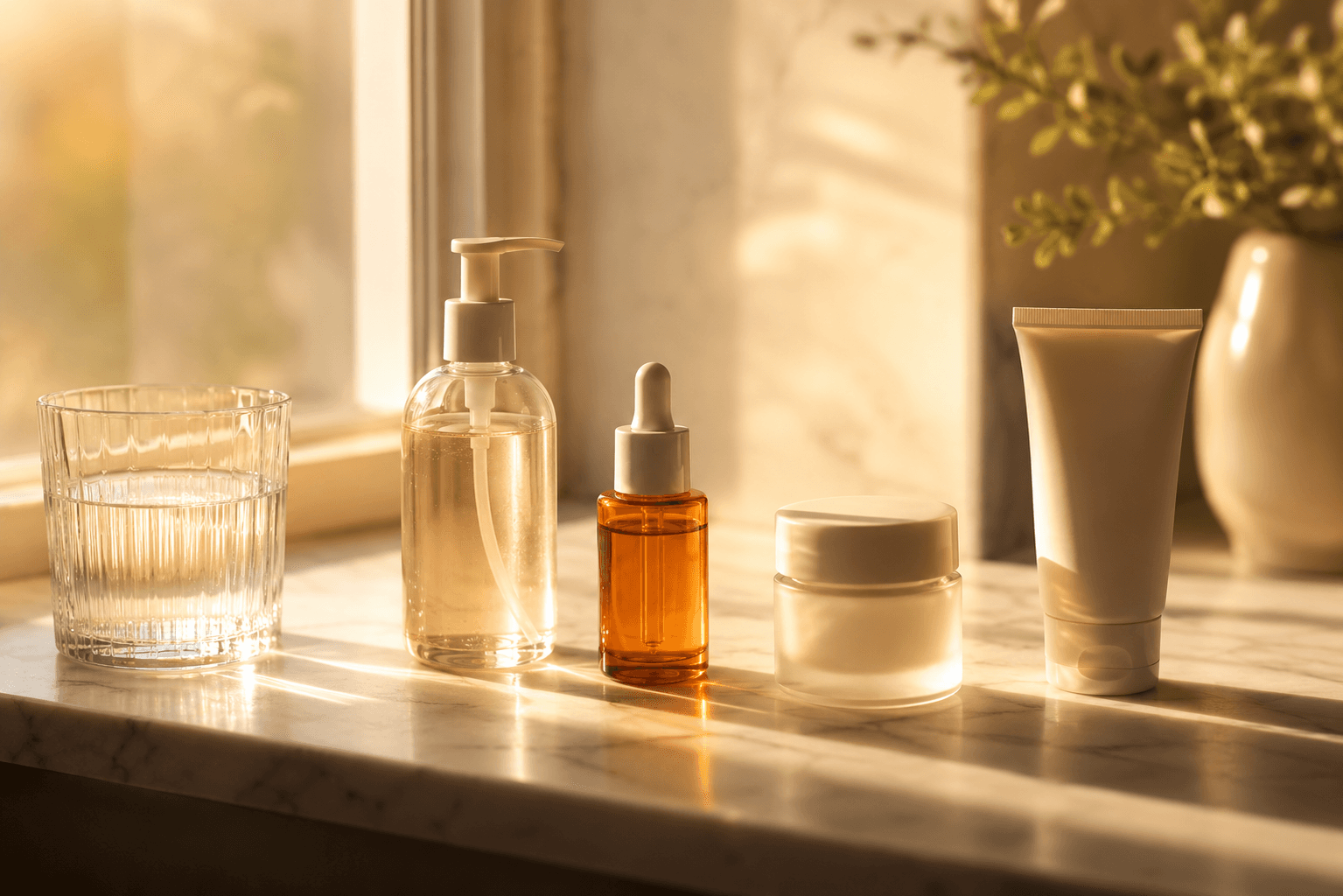
The morning routine has one job the evening routine doesn't: protect. Your skin spent the night repairing. Now you're sending it out into UV, pollution, and oxidative stress for the next 12–16 hours. The morning is about making sure it can handle that.
I keep mine simple for that reason. Cleanse, protect, seal. Everything else fights for the gaps between those three.
Why Morning and Night Routines Are Different
Evening routines are repair-focused. The retinol, the acids -- they need time and a dark, low-stimulus environment to do their job.
Morning routines are protection-focused. Antioxidants up front, barrier support, SPF on top. That's really it. Everything else is optional.
Some things genuinely don't belong in the morning. Retinol goes at night -- UV breaks it down and it makes your skin more sensitive to light. Same with AHAs. Benzoyl peroxide is another one -- it can oxidise in sunlight and interfere with whatever SPF you put over it. I didn't know any of this for a few years, and it showed.
Once the logic clicks, the morning routine gets a lot simpler. Protect in the morning. Repair at night. For the full picture on product layering, the skincare routine order guide has it step by step.
As an Amazon Associate, I earn from qualifying purchases.The Morning Routine: Step by Step
Step 1: Cleanse (Or Just Rinse)
For years I cleansed every single morning with a full lather, same as at night. I didn't know I was stripping everything my skin had spent the night rebuilding. Unless you have genuinely oily skin producing real overnight sebum, a full surfactant cleanse first thing isn't necessary -- and for a lot of people it's actively counterproductive. Just rinse.
Oily skin? Cleanse properly -- overnight sebum is real. CeraVe Foaming Cleanser or La Roche-Posay Effaclar -- I've used both, neither strips. CeraVe Foaming Facial Cleanser
Normal or dry skin, I wouldn't bother with product. CeraVe Hydrating Cleanser or Cetaphil if you need the comfort of doing something. That's plenty.
That's it. Not a deep clean.
Step 2: Toner or Essence (Optional)
The toners I used in my twenties were embarrassing -- alcohol-heavy, smelled harsh, left my face feeling tight, which I somehow thought was the goal. They were not.
Modern hydrating toners are a different product entirely. Hyaluronic acid or glycerin-based ones help the steps after them absorb better. I skip it most mornings. My skin honestly doesn't care.
Skip: The harsh ones -- alcohol, witch hazel, anything that smells like it wants to strip something. That's the old toner playbook.
Consider: The Pyunkang Yul Essence Toner is what I'd point to -- minimal ingredients, does what it promises. The COSRX AHA/BHA one is worth it for oily skin but only if SPF is going straight on top. Pyunkang Yul Essence Toner
Step 3: Vitamin C Serum
Vitamin C every morning since 2017. Before SPF, not after -- order matters. It catches the free radicals UV produces that SPF can't handle on its own.
Three or four drops, give it about a minute before you layer anything over it. Brightening takes weeks. The protection is working from day one.
Best options: I use TruSkin. 20% L-ascorbic acid, not expensive, gets results. La Roche-Posay Pure Vitamin C if sensitive skin is a concern. SkinCeuticals C E Ferulic if you've gone deep on this and the price isn't stopping you. TruSkin Vitamin C Serum
Too irritating? Ascorbyl glucoside is gentler. Gets there, just slower.
Step 4: Treatment Serum (Concern-Specific)
One serum per routine -- not three. Pick whatever addresses what's actually bothering you most:
For pores and oiliness: Niacinamide 5–10%. My T-zone used to be shiny by midday regardless of what I used -- niacinamide made a visible difference to that. I keep going back to The Ordinary 10% + Zinc. The Ordinary Niacinamide 10% + Zinc
For hyperpigmentation: Tranexamic acid or alpha arbutin -- no photosensitivity with either, both fine in the morning. The Inkey List Tranexamic Acid Serum is where I'd begin.
For dehydration or dullness: Hyaluronic acid under your moisturiser. The Ordinary 2% + B5 -- cheap, works, done.
For anti-aging (non-retinol): Peptides AM, retinol strictly PM. The Ordinary Buffet covers the morning side of that.
Step 5: Eye Cream
Ring finger, orbital bone, not directly on the lid. A small amount is all you need.
For mornings, caffeine is the ingredient that actually does something visible -- takes down the puffiness. Peptides are there for the long term.
I'd start with The Inkey List Caffeine. Works. CeraVe Eye Repair Cream is just as good. The Inkey List Caffeine Eye Cream
Step 6: Moisturiser
Lighter in the morning than at night -- SPF is going over it, no need for anything heavy. Gel or gel-cream is what works for me.
For oily skin: Hydro Boost Gel-Cream most days. I'll swap in Paula's Choice RESIST when I want a change. Neutrogena Hydro Boost Gel-Cream
For normal to dry skin: CeraVe AM SPF 30 does both in one -- I use it a lot on rushed mornings. CeraVe AM Facial Moisturizing Lotion SPF 30
For sensitive skin: First Aid Beauty Ultra Repair Cream or Vanicream Moisturising Skin Cream -- no fragrance, ceramides, nothing that aggravates. My whole criteria.
Step 7: SPF -- The Most Important Step
SPF every morning, eight years running. The one thing I won't cut. If the whole routine came down to one step, this is it -- nothing else comes close for what it prevents.
Final step, over everything, give it about a minute before you go outside. Two fingers' worth for face and neck -- most people apply way less than that and wonder why it's not performing.
For oily or acne-prone skin: My derm pointed me to EltaMD UV Clear years back and I never switched -- lightweight, niacinamide included, doesn't clog anything. EltaMD UV Clear SPF 46
For dry or sensitive skin: The Anthelios Mineral from La Roche-Posay or CeraVe's Hydrating Mineral Sunscreen. Both zinc oxide. My reactive skin handles them fine. La Roche-Posay Anthelios Mineral SPF 50
For normal skin: Supergoop! Unseen Sunscreen SPF 40. Invisible, no white cast. Doubles as primer if that matters.
Neutrogena Ultra Sheer Dry-Touch SPF 100 is around $12 and leaves no white cast.
Morning Routines by Skin Type
Oily / Acne-Prone
Foaming cleanser, niacinamide serum, gel moisturiser, SPF 46+.
Dry / Sensitive
Water rinse or gentle cleanser, hyaluronic acid, something richer, mineral SPF 50.
Normal / Combination
Gentle cleanser, vitamin C, moisturiser, SPF 30-50.
Anti-Aging Focus
Gentle cleanser, vitamin C, peptides, eye cream, moisturiser, SPF 50.
Minimal (3 Steps)
Rinse. SPF moisturiser. Done.
Three steps is a real routine. Consistent beats thorough, every time.
What Not to Put in Your Morning Routine
Retinol: UV degrades it and sensitises your skin. PM only.
AHAs (glycolic acid, lactic acid): Same photosensitivity issue as retinol. PM only -- unless SPF goes straight on top.
Benzoyl peroxide: oxidises in sunlight, messes with SPF. Evening only.
Strong acids: same photosensitivity concern as AHAs. Chemical exfoliation at night.
Frequently Asked Questions
Do I need to cleanse in the morning if I cleansed at night?
Dry or normal skin, a rinse is fine. I don't even use product most mornings -- maybe two or three times a week. Oily or acne-prone, yes, cleanse -- but gentle is the key word. Nothing stripping.
Can I skip moisturiser if I'm using SPF?
Most dedicated SPFs don't hydrate enough on their own. CeraVe AM SPF 30 is one that does both -- if that's what you're using, you're covered. Separate SPF? Moisturise first.
How long should I wait between steps?
I give vitamin C a full 60–90 seconds -- it needs to actually absorb before you layer over it. Other serums, 30 seconds is fine. SPF goes on last and I wait about a minute before leaving the house. The timing between the other steps? I don't count.
Is SPF 30 enough or do I need SPF 50?
SPF 30 blocks 97%. SPF 50 blocks 98%. Looks the same on paper. But nobody applies as much as they should, so the buffer matters. I use 50+.
Should my morning routine change in summer vs. winter?
Yes. Go lighter on moisturiser in summer, richer in winter. The SPF never changes -- clouds don't block UV, and I have a February sunburn somewhere in my past to confirm that.