
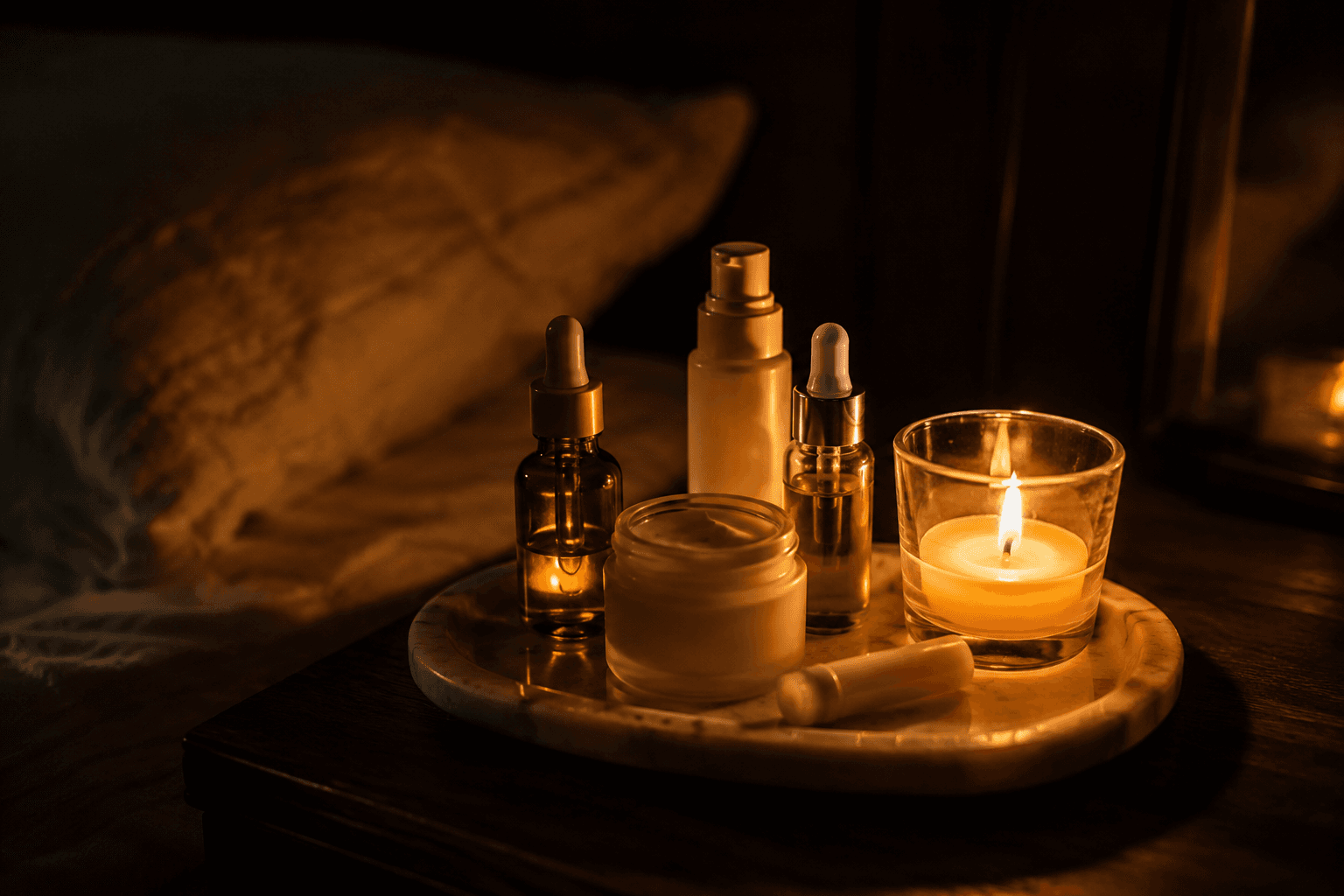
I ignored my nighttime routine for years. A cleanser if I remembered, moisturiser sometimes, nothing else. Then I started actually paying attention and my skin improved more in three months than it had in the previous three years. What you put on at night has more time to work than anything you apply in the morning routine -- your skin isn't managing UV or pollution, it's just absorbing.
Most people use that window poorly -- or not at all.
This is the nighttime routine that actually supports the repair cycle your skin is already doing.
Why Nighttime Skincare Hits Different
Daytime is UV and pollution. At night that stops and something else happens instead. Cell turnover happens mostly while you sleep -- which is why a good nighttime routine makes more of a difference than people expect. You'll wake up slightly drier than when you went to sleep. Normal -- moisture moves inward overnight. What you put on before bed feeds that.
Two things follow from this: retinol and acids go on at night because they increase photosensitivity, and your night moisturiser should be richer than your day one. Those aren't arbitrary rules -- they come from what your skin is actually doing while you sleep.
As an Amazon Associate, I earn from qualifying purchases.The Nighttime Routine: Step by Step
Step 1: Oil Cleanser or Micellar Water (Double Cleanse)
Regular cleanser doesn't actually remove sunscreen properly. Sunscreen is oil-based -- water alone won't break it down. I had clogged pores for months before I worked out that my cleanser wasn't actually getting everything off. Oil cleanser fixed it.
Apply to dry skin, massage for about a minute, then rinse. You're just breaking down whatever's sitting on top -- the actual cleanse comes next.
I use the Bioderma Sensibio H2O most nights -- gentle, no residue, does the job. The DHC Deep Cleansing Oil is what I'd try first if you prefer an actual oil over micellar water.
Step 2: Gentle Water-Based Cleanser
After the oil cleanser, your regular cleanser goes on next. This is the one that actually cleans your skin -- the oil step just cleared the way.
Lukewarm water only. Hot water strips your barrier -- I used to shower with water that was too hot and wondered why my skin felt tight and reactive every morning. Pat dry, don't rub.
The CeraVe Hydrating Cleanser is what I use. La Roche-Posay Toleriane is worth knowing about too -- I switched to it when my skin was being difficult and it was noticeably kinder.
Step 3: Exfoliant (2–3x Per Week, Not Every Night)
This step isn't nightly -- and if you're using retinol, skip it on retinol nights entirely.
On nights when I'm not using retinol, the exfoliant goes here -- on dry skin, a few minutes to sit before I continue. The two don't go on the same night. Tried it once. Irritated for days.
- AHA (glycolic acid, lactic acid): What I use for texture and old pigmentation. The Ordinary Glycolic Acid 7% is what I reach for -- dry to normal skin is where it works best.
- BHA (salicylic acid): Oily or congested skin -- goes into pores in a way AHAs don't. I ended up on Paula's Choice BHA Liquid Exfoliant.
Start once a week if you're new and build up slowly. Over-exfoliation is one of the most reliable ways to trash your barrier -- I've done it.
Step 4: Treatment Serum
This is where you put on whatever you're actually trying to fix. One active at a time -- mixing things up before you know how your skin responds to each one is how people run into trouble. Eight to twelve weeks minimum before you decide if something's working.
For anti-aging and texture:
Retinol or retinoid. Start at 0.025–0.05% if you're new to it -- I started at 0.025% and still had a rough adjustment period. Pea-sized amount, whole face. More isn't better. Expect some purging and flaking in weeks 2 to 4 -- push through it. I ended up on The Ordinary Retinol 0.5% in Squalane.
For hyperpigmentation and uneven tone:
Niacinamide at 5 to 10%, tranexamic acid, or alpha arbutin. All gentler than retinol -- no building up, nightly from the start.
For barrier repair:
Ceramide serum or a cica serum. I reach for these when I've overdone the actives and my skin is kicking back -- they settle things without adding anything else to deal with.
Step 5: Eye Cream
Eye cream before moisturiser -- ring finger, orbital bone, not on the lid. Ring finger because it uses the least pressure. I used to tap it right onto the eyelid and wonder why it wasn't doing much.
Caffeine or vitamin K for dark circles, peptides for lines. I'll be straight -- no eye cream I've used made a fast difference to my dark circles. Months of consistent use is closer to the truth.
A lot of eye creams are overpriced moisturisers in small packaging. You don't need to spend much here. I use the CeraVe Eye Repair Cream. The Inkey List Caffeine Eye Cream is what I'd try first if you want something cheaper -- does the job.
Step 6: Moisturiser
At night I go richer. No SPF needed, no mattifying agents, so you can actually go heavier. I use something noticeably thicker at night than I do during the day.
For normal to dry skin:
I keep coming back to CeraVe Moisturising Cream. Neutrogena Hydro Boost and First Aid Beauty Ultra Repair Cream both work too.
For oily or acne-prone skin:
Gel-textured moisturisers, not heavy creams. Skipping it entirely when you're oily is a mistake I made for years -- your skin just produces more oil in response. The Belif Aqua Bomb and Cetaphil Oil Control are both good options.
For aging or very dry skin:
A sleeping mask on top of your moisturiser a few nights a week makes a real difference. It seals everything in. I've used the Laneige Water Sleeping Mask for years. The Glow Recipe Watermelon is lighter.
Step 7: Facial Oil (Optional)
Dry skin or dry season -- a facial oil goes on last and seals everything in. Oils don't add hydration -- they seal in what you've already put on.
Squalane is what I use -- light, non-comedogenic, fine for all skin types. Rosehip is good if you want something with anti-aging benefits. Marula works well too.
Oily or acne-prone, skip this.
Nighttime Routines by Skin Type
Dry Skin
Gentle cleanser, ceramide serum, eye cream, rich moisturiser. Facial oil if you want extra seal.
Oily / Acne-Prone Skin
Double cleanse. BHA or retinol on alternating nights, not both. Light gel moisturiser.
Normal / Combination Skin
Cleanser, serum, eye cream, moisturiser. That's it.
Sensitive Skin
Gentle cleanser, centella or niacinamide serum, fragrance-free moisturiser. Not the time for retinol or acids.
Common Nighttime Routine Mistakes
Retinol and AHAs on the same night too soon. Both are exfoliants. I did this before I knew better and my skin was red and flaky for a week. Give each one a few weeks on its own first.
Skipping moisturiser when you're oily. Oily skin still dries out at night. I did this for years -- my skin just produced more oil in response. Counterproductive.
Applying actives to damp skin. Dry skin first, then actives. I've rushed this more than once. Redder the next morning every time.
Stacking too many actives. I've done this -- retinol, glycolic, vitamin C, niacinamide all on the same night. Barrier was wrecked for two weeks. Pick one thing.
Frequently Asked Questions
How long should a nighttime routine take?
Ten minutes if you're doing it properly. A few extra for double cleansing. I've done a stripped-down version of this routine in under four minutes on tired nights -- quick cleanse and something on top is still better than nothing.
Do I need a separate night cream?
Not necessarily. Any good moisturiser works day and night. The practical reason to use something different is that most daytime formulas have SPF and mattifying agents -- things you don't need while you're asleep. I use a separate pot at night because what I want in the evenings is richer than what I want under makeup.
Should I use retinol every night?
Only once your skin has adapted. Start 2 to 3 nights a week and build up over a couple of months. I've been using retinol for years and still only do it every other night -- the results are about the same and my skin handles it better that way.
What if I fall asleep without doing my routine?
Cleanse at minimum. Sunscreen and makeup left on overnight does far more damage than a skipped serum. Tired nights -- just the cleanser and a bit of moisturiser. Two minutes. That's enough.